Classroom Is the Last Refuge: How Lebanon’s Children Paid for Someone Else’s War
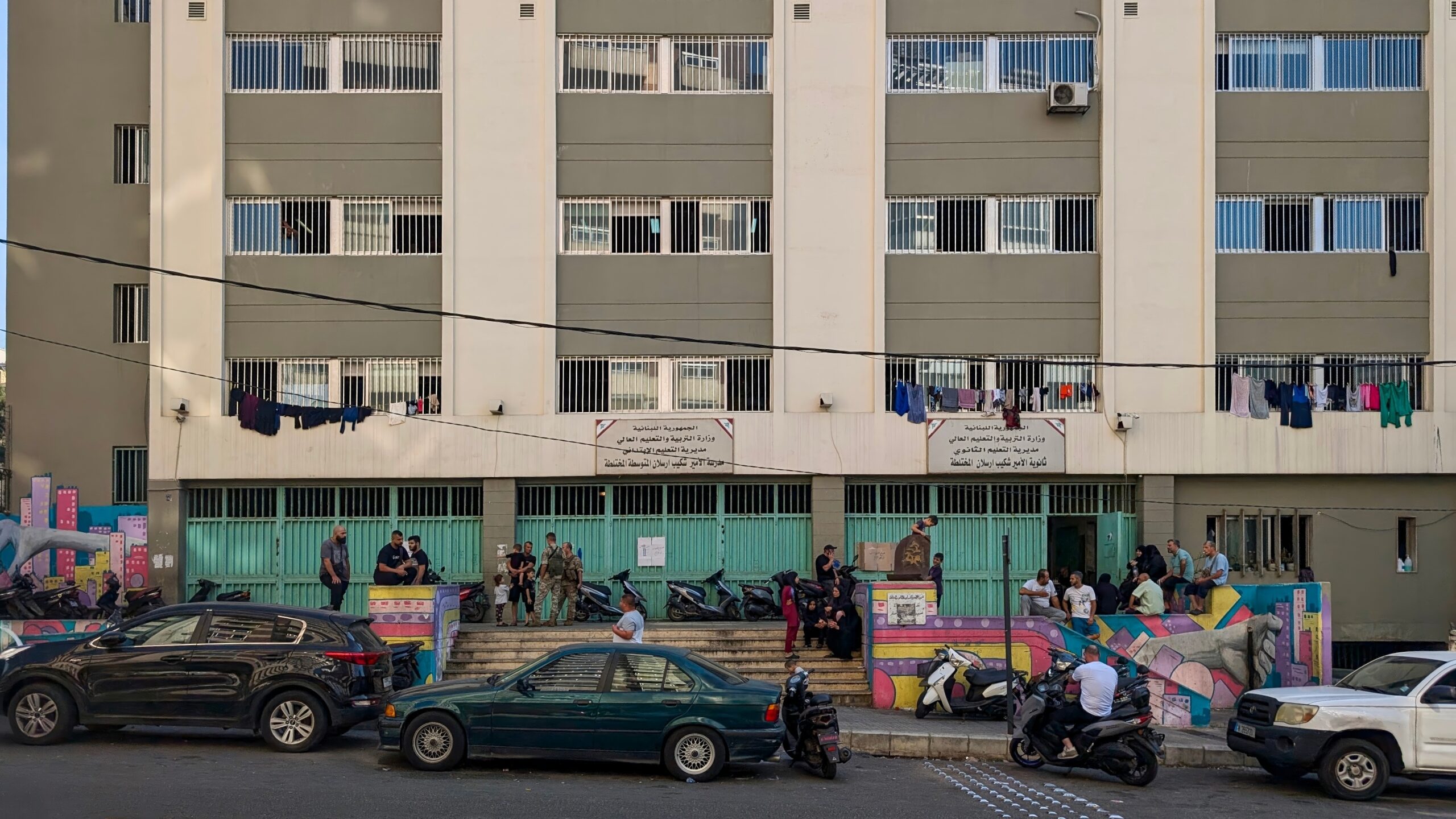
In the summer of 2026, I visited Beirut, where nightlife seemed to be proceeding normally. Music was playing in some places, while the sound of drones could be heard in the background. The next morning, I visited a school that had been turned into a shelter for families displaced from Southern Lebanon. Children were trying to play, while families cooked, washed clothes, and searched for privacy in a space never designed for housing. This experience made me consider a larger question: what happens when a place designed for educating children becomes a refuge for families who have lost their homes? And who chose this school to become a shelter?
The War That Lebanon Did Not Choose
On 2 March 2026, Hezbollah fired rockets into Israel. The same day, the Lebanese government banned Hezbollah’s military activity and ordered it to hand over its weapons, but the decision was never enforced. Hezbollah’s leader Naim Qassem refused negotiations with Israel, calling them “surrender”. On 31 March, ten European foreign ministers stated: “Responsibility for the current situation lies with Hezbollah.”
The war that displaced over one million people was not a choice made by Lebanon as a whole. Hezbollah’s decision to enter the confrontation and Israel’s military response brought devastating consequences for civilians, including children.
In March 2026, the Lebanese Ministry of Education and Higher Education issued Circular No. 17/M/2026, a directive ordering schools to keep teaching under exceptional circumstances, an early sign that the state intended to respond, even as its capacity to do so was already in question. The displacement placed enormous pressure on public institutions, including schools. Around half a million school-age children were among those affected, according to estimates published at the time.
Numbers alone, however, do not explain what is happening inside schools. Nor do they show the difference between schools that were merely designated as possible shelters and those that actually filled with displaced families.
Already on 17 March 2026, the London-based pan-Arab daily Asharq Al-Awsat reported that hundreds of public schools, vocational institutes, and Lebanese University were being prepared to use as shelters. Later assessments by UNESCO and UNICEF put the number of educational institutions converted into collective shelters in the range of roughly 430 — different reports, slightly different counts, but the same picture: a large share of Lebanon’s public education infrastructure absorbed into the shelter system.
When a School Becomes a Shelter: Education at the Heart of the War
Education has long held an important place in Lebanese society, but the war has raised questions whether lessons can continue. A school sheltering displaced families provides a necessary humanitarian service, but in doing so it is stripped, temporarily or indefinitely, of its ability to fulfil its original function.
UNICEF assessed over a thousand educational facilities and reported that more than 400 have been damaged in the attacks since 2 March 2026, on top of the damage already inflicted in the 2024 war. Of these, 37 were completely destroyed and another 64 were severely damaged. Almost 300 of these damaged facilities were in the governorates of South Lebanon and Nabatieh. Different reports give somewhat different figures, in the range of roughly 340 to 440 schools affected, depending on date, coverage and how damage is defined, but the scale of disruption is clear, and it makes restoring school life complex even when fighting stops.
The civilian toll of Israeli military operations was also severe. In a statement on 9 April 2026, UNICEF reported that Israeli airstrikes the previous day had reportedly killed 33 children and injured 153. These figures document the toll on children; they do not by themselves settle the separate legal question of whether civilians were deliberately targeted.
According to MEHE and UNICEF’s joint report, around 27% of learners in Lebanon faced an interruption in their education, while around 200 000 experienced severe disruption in areas affected by the war. Nearly 100 000 children were unable to return to education because of damaged or destroyed schools, fear, restricted mobility, or displacement. The same report also recorded at least 86 teachers killed or injured and found that 26% of learners with special educational needs had been displaced. As of October 2026, it remained unclear how many school-aged children were receiving regular teaching; what the data showed was that a large share were still out of classrooms.
According to UNICEF, four in five households in Lebanon are now struggling to afford basic necessities, and 17 % report that their children have stopped attending school altogether. Remote learning was not a solution for everyone. Poor internet connectivity, unstable electricity, and several children sharing one device made following lessons more difficult.
The crisis is therefore not simply about school closures or postponed lessons, but children’s ability to learn in safe, stable conditions. Displaced children have often lost their homes and schools while also facing disrupted routines, limited access to learning materials, and a lack of suitable study space. Syrian refugee children, already among Lebanon’s most vulnerable, were disproportionately affected — for many of them, this was not the first school year lost.
South Lebanon Between the Housing Crisis and the Postponement of the School Year
In late August 2026, the Associated Press reported that around 80 schools were still being used to shelter displaced people. In one school in Tyre, around 200 families were living inside the building. Georgia Hachem, an adviser at the Ministry of Education, explained that school-specific plans were being developed to resume teaching while addressing the needs of displaced people. Efforts included moving some families to designated shelters or unused buildings, particularly in Beirut.
In an Al Jazeera field report from August 2026, Fatima, a displaced woman whose home had been destroyed, was living with her family in a classroom at the Lebanese-Kuwaiti Public School in Sidon. Around 400 people were residing in the school as it prepared to receive and register students. The principal, Widad Jaradi, explained that administrative and educational work was being organized separately from shelter management, with an association following up on families’ needs and efforts underway to move them to separate shelters. A Sidon municipality official said some schools were trying to set aside physically separate spaces for students and displaced families, though she called this a temporary arrangement that could not last long.
This case shows how a school may try to provide shelter while preparing to receive students. Yet separating the two functions administratively or physically does not necessarily separate them in daily life. Limited privacy and overlapping between everyday activities and study can make learning difficult.
But where can families go if they are asked to leave a school before an alternative shelter is secured? If schools are the last refuge for families who have lost everything, and other shelters are insufficient, can families be asked to leave before real alternatives are available, or does that force them to choose between temporary shelter in a school and the streets?
State Sovereignty and the Education Crisis
Why the Lebanese government could not prevent or contain the war is closely linked to the crisis facing its schools. Although the cabinet banned Hezbollah’s military activity on 2 March 2026, the decision was never enforced. The state’s difficulty in enforcing its laws against a powerful non-state actor with close ties to Tehran raises fundamental questions about Lebanese sovereignty — a theme explored in an earlier post on this blog.
The Washington Institute notes that Beirut “chose not to choose,” fearing internal conflict. The Lebanese Army halted operations north of the Litani River because Hezbollah threatened to attack the state. A truck carrying 250 kg of TNT and 250 kg of C4 explosives was intercepted at Dahr al-Baidar, and both arrested individuals were Hezbollah members. The Justice Minister stated these materials were capable of “blowing up an entire neighborhood.”
This is not simply a question of administrative capacity, but also of sovereignty. When the state faces constraints on enforcing its authority against an armed group, the consequences extend beyond security and politics. Schools becoming shelters is not proof of state failure, but it shows how limits on state’s capacity can deepen a humanitarian crisis.
Beyond the Education Crisis
This weakness is not new. Lebanon’s public education system was already in deep crisis long before March 2026. Since 2019–2020, schools have functioned only partially, propped up by international donors whose emergency funding was used to supplement teacher salaries and even to supply electricity. School years started late, teaching ran for only part of the week, and months-long teacher strikes became routine as salaries no longer covered the cost of living. The current crisis, caused by the Israeli strikes, did not create this weakness, it exposed and deepened it.
Turning schools into shelters cannot be viewed separately from the conditions that made it necessary. When families lose their homes, shelter becomes an urgent priority, and they cannot be asked to leave a relatively safe place without a suitable alternative. At the same time, children cannot wait indefinitely for conditions to stabilize before regaining their right to education.
Reopening schools requires alternative shelters, repairs to damaged buildings, educational resources, and support for children, teachers, and families facing difficult living conditions. It has been said, only half-jokingly, that Lebanon’s most valuable export is its well-educated young people, and prolonged disruption to schooling puts that too at risk. Thus, the challenge is not only to reopen schools, but to build lasting capacity to protect education when the next crisis occurs.
The crisis also has a regional dimension. Hezbollah’s relationship with Iran is central to debates about the group’s military decisions and Lebanon’s sovereignty. David Hale, former US ambassador to Lebanon, said: “Hezbollah takes its orders from Iran… joining this war went against the interests of all Lebanese.” This perspective places the crisis facing Lebanese schoolchildren within a wider regional struggle, in which decisions made beyond Lebanon’s borders can have profound consequences for its population. And if the war ends tomorrow, will Lebanon be able to return its children to their schools, or is the crisis deeper than a truce alone can solve?
Even if a ceasefire is reached, Lebanon cannot simply return to what it was. As long as Hezbollah retains its weapons, Iran continues to exert influence over its decisions, and Israel occupies new parts of southern Lebanon, the risk remains that Lebanon will again pay the price of a war its people did not choose. Ultimately, the crisis facing its schools is also a question of the Lebanese state’s ability to protect its people and provide for their future.
References
- Lebanese Ministry of Education and Higher Education — Circular No. 17/M/2026, 9 March 2026
Minister Karami issued a circular on ensuring the continuity of education under exceptional circumstances | Ministry of Education and Higher Education - Asharq Al-Awsat — ”War Disrupts Education in Lebanon, Deepening Inequality Among Students,” Paula Astih, 17 March 2026
- UNESCO — Data on educational institutions used as shelters, 9 April 2026, with a later update
In Lebanon, UNESCO allocates $650,000 to support the continuity of - UNICEF — ”Lebanon’s Schools Caught in the Crossfire,” September 2026
Lebanon’s schools caught in the crossfire | UNICEF Lebanon - Associated Press — Report on schools sheltering displaced people ahead of the start of the school year, August 2026
- Al Jazeera — ”The Bell Is Approaching and Classrooms Are Still Homes.. How Will Lebanon’s Students Return to Their Schools?” Najia Dehsheh, 29 August 2026
- L’Orient-Le Jour — Reports on Lebanese government decisions and Hezbollah’s response, March 2026 Government announces ‘total ban on any military activity’ by Hezbollah – L’Orient Today
- The National — Joint statement from ten European foreign ministers, 31 March 2026 Lebanon: foreign ministers’ joint statement, 31 March 2026 – GOV.UK
- Washington Institute for Near East Policy — Analysis on Lebanese government and Hezbollah disarmament, 2026 Can Hezbollah Be Dismantled? | The Washington Institute
- Wilson Center — Interview with David Hale on Hezbollah and Iran, 2026 An Interview with Amb. David Hale on Lebanon amidst the US-Israeli War with Iran | Wilson Center
- UNICEF statement on intensified strikes on Lebanon and the devastating impact on children UNICEF statement on intensified strikes on Lebanon and the devastating impact on children | United Nations in Lebanon
- The Impact of the War on Lebanon’s Education Sector
Cover picture: A school in Beirut repurposed as a shelter for hundreds of displaced families Beirut, Lebanon 10.9.2024. Photo: Ali Chehade Farhat.
Kirjoittaja
Yehya Alhajji
Yehya Alhajji on kasvatustieteen väitöskirjatutkija Jyväskylän yliopistossa. Hänen tutkimuksensa keskittyy varhaiskasvatukseen, koulutukseen ja koulutuspolitiikkaan. Hänellä on myös kansainvälisten suhteiden maisterintutkinto, ja hän on kiinnostunut erityisesti koulutuksen, politiikan ja yhteiskunnallisten muutosten välisistä yhteyksistä Lähi-idässä.
Aiheeseen liittyvät artikkelit
Mitä pääsy UNESCOn maailmanperintöluetteloon tarkoittaa sodan runtelemalle Beaufortin linnalle?
Mitä kuuluu Libanonin kulttuuriperinnölle?
Valkoinen fosfori ja kansainvälisen oikeuden harmaa alue