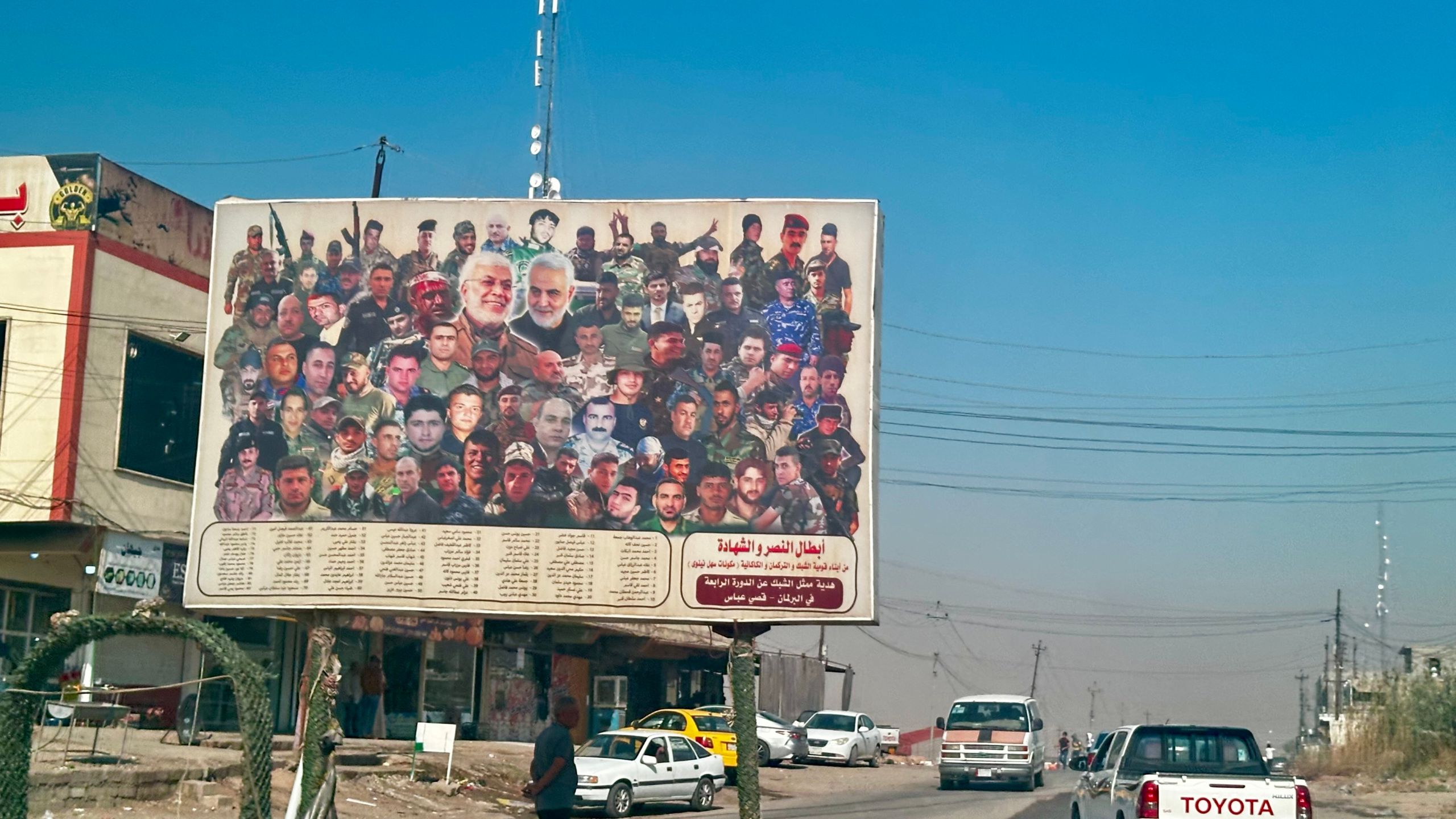
The War Against Iran Is Likely to Destabilize Iraq
War between United States, Israel, and Iran is once again pulling Iraq into the region’s fault lines. As Iranian backed militias mobilize and oil dependent finances face new pressure, the country risks seeing fragile stability slip away.
On a street near Baghdad’s Green Zone, a young Iraqi man stood waving an Iranian flag and shouting at the riot police trying to keep protesters away from the U.S. Embassy. Behind plastic shields and drifting clouds of tear gas, the standoff served as a stark reminder: Iraq has yet to break free from the region’s cycle of conflict.
Far from Baghdad, more than 30,000 people of Iraqi origin now live in Finland, according to the latest figures from the Finnish Immigration Service for 2024–2025. Iraqis also rank among the largest groups receiving Finnish citizenship, with roughly 2,000 obtaining Finnish passports in 2025 alone in search for stability and opportunity.
Those numbers trace a journey that began with the large wave of asylum seekers arriving in Europe in 2015 and 2016. The migration followed years of upheaval in Iraq after the 2003 U.S.-led invasion – first the collapse of internal security through sectarian war and blasts, then the sweeping advance of the so-called Islamic State across major Iraqi cities. Although the militant group was ultimately defeated militarily, the postwar period produced a complex political and security landscape.
The Popular Mobilization Forces (PMF) were formed in 2014 after Grand Ayatollah Ali al-Sistani issued a fatwa calling on Iraqis to take up arms against ISIS following the fall of Mosul. Then-Prime Minister Nouri al-Maliki institutionalized a number of existing militias under the PMF umbrella, while Iran’s Islamic Revolutionary Guard Corps simultaneously mobilized allied Shiite factions. Over time, several of these groups have developed close ties to Tehran and emerged as powerful actors across Iraq’s security and political landscape, and become powerful actors within Iraq’s security and political system even as the U.S. military presence shrank to about 2,500 troops and advisers.
Return Hopes Meet a Fragile Security Environment
By 2024, tentative signs of relative stability had begun to emerge, encouraging some Iraqi professionals living in Europe to consider returning and launching new ventures. Among them was Iraqi musician Ali Haitham, who returned to Baghdad with his Finnish ensemble and staged large-scale performances in the heart of the capital. He later funded a project to establish Iraq’s first Finnish-style kindergarten, staffed by Finnish educators. Speaking to me on the phone, Haitham said that “three Finnish employees have currently stopped working until things return to normal, though he remains cautiously optimistic. “We hope to return to business as usual in a week or two,” he added.
Finnish companies also expanded their footprint. Firms such as Nokia and Wärtsilä increased their involvement in projects tied to telecommunications, infrastructure, and energy, deploying engineers and technical experts on the ground in Iraq.
Yet these modest signs of progress now face a new test as regional tensions escalate. Since Finland joined the NATO in 2023, some analysts at the Finnish Institute of International Affairs have raised questions about whether that shift could alter how certain armed factions in the Middle East perceive the Finnish presence in Iraq – once regarded as relatively neutral among Western actors.
Iraq Once Again in the Crossfire
The military escalation that erupted on Feb. 28th, 2026, between the United States and Iran has quickly pushed Iraq back into its familiar role as a theatre for regional confrontation. Iran-aligned militias have claimed responsibility for drone and rocket attacks targeting sites linked to U.S. forces in Baghdad, Erbil, and Basra.
In response, the United States carried out retaliatory strikes on positions associated with those factions. Preliminary data released by Iraq’s Interior Ministry indicate that the attacks left multiple casualties, while U.S. forces reported no fatalities among their personnel.
In Baghdad, hundreds of Pro-Iranian militia protesters gathered near the Green Zone – home to foreign embassies and key government institutions – to denounce the U.S. strikes. Some demonstrators attempted to push toward the fortified district, prompting clashes with riot police that left several security personnel injured.
Vulnerable Oil-Dependent Economy
Beyond the immediate security risks, Iraq faces also a deeper structural challenge: its overwhelming dependence on oil revenues makes it vulnerable to Iran’s tactic of closing the Strait of Hormuz. According to Iraqi financial data, oil accounts for roughly 88 % of government income.
Iranian forces attacked two fuel tankers in Iraqi waters near Basra, setting two vessels ablaze and killing at least one crew member, according to port officials Wednesday night.
In 2025, Iraq collected about 114 trillion Iraqi dinars, equivalent to 75 billion euros, in public revenue, of which roughly 100 trillion came from oil exports. Such reliance means that any disruption to energy exports would quickly undermine the state’s ability to finance its basic obligations.
The government requires roughly 8 trillion dinars, about 52 billion euros, each month to cover salaries for public-sector employees and pensions. While revenues have so far remained stable, any interruption to export routes – particularly through the Gulf – could place severe strain on the national budget.
Signs of this fragility already emerged in 2025, when delays in salary payments to some public workers and retirees triggered criticism and heightened social tensions.
The Struggle for Sovereignty
At its core, Iraq’s challenge remains one of sovereignty. In a region where regional powers, global actors and transnational armed networks intersect, insulating the Iraqi state from external rivalries has proved extraordinarily difficult.
The question now is whether Iraq can prevent its territory from once again becoming a battleground for competing powers – and preserve the fragile prospects for stability and economic activity that had begun to reappear only recently.
Cover photo: Photo of an Iran-backed militia on a billboard in Mosul on 30 October 2024. Picture: Obaida Hitto.
Kirjoittaja

Safa Al-Khalidi
Safa Al-Khalidi is interested in risk management and how risk, uncertainty, and resilience shape decision-making in intercultural and policy contexts, and holds the international certification of ISO 31000 Lead Risk Manager. She also has a bachelor’s degree in biotechnology. At the moment she works for FIME as a research assistant.
Aiheeseen liittyvät artikkelit
Irakin näyttävä korruptionvastainen kampanja ei ulotu vallan ytimeen
Valkoinen fosfori ja kansainvälisen oikeuden harmaa alue
Lähi-itä palaa! Aavikoituminen ja ympäristövahingot uhkaavat Kaksoisvirranmaata