Iraq’s future hangs in the balance as political deadlock and the impacts of the Iran war accumulate
Following Iraq’s November parliamentary elections, government formation has once again stalled over disputes concerning the selection of a president and prime minister. Iraq has turned into one of the battlefields of the US–Iran conflict, meanwhile it is led by an interim government with very limited power. It is becoming increasingly complicated to maintain a balance between Iran and the US as both Iranian-backed paramilitary groups and the US carry out attacks on Iraqi soil. The attacks are dragging Iraq deeper into the conflict, while oil exports from southern Iraq have been halted as a result of the closure of the Strait of Hormuz. The economy is at risk of collapse, and the situation could escalate into a humanitarian crisis in the summer if the situation is not brought under control.
It was hardly a surprise that Prime Minister Mohammed Shia Al-Sudani and his party were the winners of Iraq’s November parliamentary elections, followed by veteran politician Nouri Al-Maliki. Government formation talks started slowly, as expected. After ratifying the election results, parliament should elect the speaker of parliament, after which it has 30 days to vote for the president. In a fortnight from that, the president must appoint the prime minister who gets thirty days to form a government that will be approved by the parliament. Yet again, constitutional deadlines have elapsed. As per the informal power-sharing arrangement, the speaker is a Sunni Muslim, the president a Kurd, and the prime minister a Shiite Muslim. Nonetheless, frictions within these groups have effectively brought the entire process to a standstill.
External pressure is tearing apart the Shiite coalition
The Shiite coalition of various factions has faced internal rifts for a long time, resulting in challenges in the choosing of a PM. The coalition even consulted Grand Ayatollah Ali Al-Sistani, who ultimately chose not to take a position. In the end, the election victor Prime Minister Mohammed Shia Al-Sudani stepped down from nomination for new prime minister to ease tensions.
Nouri Al-Maliki was nominated by the Coordination Framework as its candidate for Prime Minister. He had a turbulent history during his two terms in office. Between the years 2006 and 2014, Iraq experienced a civil war, economic growth, and rise of ISIS. Al-Maliki’s role during this period is disputed, with some asserting that he operated rather well under extremely unstable conditions and oversaw economic growth driven by rising oil prices, while others argue that he has been a destabilizing force through inflammatory rhetoric and Shiite-favouring policies. During his second term in particular, the security situation deteriorated significantly, and power became increasingly centralized in the prime minister’s hands.
In Washington, Al-Maliki’s candidacy has raised concerns due to the tense relationship between him and the US during his second term. He opposed the presence of US troops and maintained close ties with the Popular Mobilization Forces, which include Iranian-backed actors. Although his rhetoric has softened, this appears to be a tactical adjustment rather than a political change. The U.S. made it clear that his appointment would lead to outcomes like economic sanctions. Iran has indicated its support for nearly any prime ministerial candidate emerging from the Shiite coalition.
Al-Maliki has fostered distrust in his very Shiite coalition, in part because of US opposition but also because his leadership might challenge the cooperation with Sunnis and Kurds. Simultaneously, giving up Al-Maliki’s candidacy may create an impression of surrendering to foreign influence. The circumstances, however, continue to evolve, and there is a way out of the deadlock. Even if he gets nominated, parliament could still vote against him allowing for another candidate, one less polarizing from within the coalition. Al-Sudani remains a possible option, while a lesser-known consensus candidate is also possible.
Initially, the coalition thought of extending Al-Sudani’s term to stabilize the situation and to contain Al-Maliki. Iraq’s Supreme Court intervened: a new legal interpretation holds that parliament loses its mandate at the moment of the election, and the interim government is only entitled to basic functions.
The root of the crisis lies in Kurdistan
Public discussions have cantered around Al-Maliki’s candidacy, but the problem really lies in Kurdistan. Rival Kurdish parties can’t agree on a presidential candidate — a choice that needs to be made before a prime minister can be selected. The situation in the Kurdistan Regional Government is even more deadlocked than at the federal level: parliamentary elections were held as early as October 2024, yet a government has still not been formed.
At the heart of this issue is an alteration in the dynamics between the two main parties in the Kurdish region, the Kurdistan Democratic Party (KDP) and the Patriotic Union of Kurdistan (PUK). Traditionally, both parties divided up power strategically, with the KDP nominating the president of the Kurdistan Region and the PUK the president of the federal state. Since the 2010s, this balance has shifted, particularly after the reformist Gorran movement split from the PUK, which eroded its support. The KDP argues that electoral results alone should determine power distribution and that cooperation with the PUK is no longer necessary. The PUK, in turn, emphasizes its regional influence and seeks tactical alliances with newer parties.
Disputes between the Kurdish parties run deeper than those within the Shiite coalition. Tensions between KDP and PUK have been steadily escalating, as the two parties have not formed an electoral alliance since the 2010s. The PUK alleges that KDP is creating a shadow government by empowering the role of civil servants while KDP blames PUK for handing over Kirkuk to the Iraqi army in 2017. Pressure is growing in parliament to move ahead with a presidential election without a unified Kurdish candidate. Nonetheless, with two-thirds majority needed, boycotts may bring this to a halt. These political manoeuvres pose a risk to the entire system. Informal power-sharing arrangements have long characterized Iraqi politics. Nevertheless, ongoing stalemate is creating vacuums in power, increasing the temptation to divert from established practices. In the absence of adherence to these principles, or in the case of their erratic movement, there will be instability and uncertainty of a systemic kind.
Who does the election result represent?
Though the official turnout was reported at 56 percent, the situation is actually more complex. Analyst Munqith Dagher points out that the turnout was calculated only for citizens with an official voting card. When this factor is taken into consideration, the turnout drops to 41 percent. In addition, around six percent of votes were declared invalid, most likely because of boycotts —or instance, military personnel and prisoners were reportedly forced to vote. The actual turnout could thus be as low as 38,5 percent.
The low participation rate is likely due to citizens not trusting the system to make changes that they seek. However, the robust backing for Al-Sudani at the polls reveals to us that voters are agreeable to bestowing rewards on actors whom they feel have improved things.
It seems like voter preferences have also shifted. According to Dagher, the performance of both secular parties and Islamist parties was worse. Nonetheless, because of electoral reforms that benefitted larger parties, Islamist groups won additional seats even as their votes dipped. The secular votes were fragmented, and some segments boycotted the elections due to disappointment with the previous government’s failure to deliver change. The findings suggest rising support for more moderate parties that combine Islamist and secular elements.
The Sadrist movement led by populist leader Muqtada Al-Sadr boycotted the elections and stayed outside the process, but Al-Sadr still holds influence, particularly through his ability to mobilize supporters. In case of not getting his demands, he could disrupt government formation by organizing mass protests. For example, Nouri Al-Maliki’s premiership could have backlash given their openly hostile relationship.
The US–Iran conflict could collapse the economy and basic services
Iraq is in a critical situation due to the US-Iran conflict. During the term of al-Sudani, Iraq was able to balance between the two and strengthen its own position, but the war is complicating things and tensions are on the rise.
Iranian-backed paramilitary forces have ramped up their activities and have even attacked the US embassy, while the US has bombed sites linked with them. Iraq is being drawn deeper into the conflict, one that the interim government cannot fully control. Al-Sudani must strike a balance: while he has condemned the attacks and stressed that only the state, not any non-state player, should have the monopoly of force, he has allowed the Popular Mobilization Forces to respond to attacks on them. These armed formations have contested state authority for quite some time; they are closely linked to political parties, and they operate with considerable autonomy.
Due to US pressure and boycotts by Sunni and Kurdish parties, a long-rumoured bill to integrate the Popular Mobilization Forces into the national army has stalled. This could mean greater control but also solidify the Iranian-backed groups into the state structures which would reduce military effectiveness and cohesion.
The clash is also causing immediate and severe economic impacts. Iraqi economy being reliant on oil exports, the closure of the Strait of Hormuz has suspended exports from the south, with the country losing $6–7 billion a month. The country’s foreign reserves are approximately $100 billion – which the central bank holds – but this is unsustainable. The economy might face collapse within a few months if the blockade continues and no interim solutions are found. The large public expenditures, such as salaries and pensions, are rapidly draining resources, while the interim authorities are not empowered to pass a fresh budget or utilize flexible emergency measures.
The future seems increasingly grim for ordinary citizens. With most food and a large share of refined fuel coming in through the Persian Gulf, Iraq is heavily reliant on imports. Supply chains are highly vulnerable. The national electricity grid depends on gas imports from Iran that have already reduced, while reduced oil production is also limiting the availability of associated gas. While private diesel generators supplement electricity shortages, the fuel for these generators is imported. Electricity may become a luxury if supply routes are disrupted or prices surge. Food prices are also rising, caused by higher transportation costs at the moment. With summer fast approaching, rising living costs and insufficient electricity for cooling could lead to a humanitarian crisis. Under such conditions, public demonstrations may once again become citizens’ only outlet.
What next?
Shiite parties, it seems, intend to wait out the crises, both internal and external, with Al-Sudani’s struggling leadership. The Kurdish deadlock offers decision-makers in Baghdad some breathing space and an opportunity to seek solutions for forming a government. Although Al-Sudani could be a stabilizing figure, the situation is very difficult for him — he authority of the interim government has been limited by a court decision and lacks the mandate needed in a crisis. The prolonged government formation negotiations and foreign influences undermine the legitimacy of the political system. 220 political figures have signed an initiative calling for immediate presidential elections.
Al-Sudani faces an almost impossible challenge, but one figure stands to benefit: Nouri Al-Maliki. As economic and security pressures increase, they play into Al-Maliki’s favour, while Al-Sudani remains constrained by the Supreme Court’s ruling. Al-Maliki seems to be waiting strategically for the right moment, as worsening conditions might cause the populace to seek a strong man. At present, however, both regional and internal tensions are too high, and his being named prime minister would likely draw a backlash from Washington and the Sadrists. By remaining in the background and allowing Al-Sudani to carry the burden, Al-Maliki could later present himself as a stabilizing force. This strategy is risky, however, as a collapse in the economic or security situation could make recovery difficult or impossible.
The ultimate decision may once again lie with Iraq’s Supreme Court. In February, a complaint was filed by the Iraqi Communist Party, together with the Social Democratic Party, to dissolve parliament as a result of the delay in the presidential election, which they argued is unconstitutional. The Court has assured to deliver judgment in April. It is unlikely that parliament will be dissolved. More likely is that the Court will be trying to pressure the Kurdish parties to agree on a joint presidential candidate or to give the Al-Sudani administration a temporary mandate. It may also revisit the 2010 interpretation, termed a miscalculation by Chief Justice Faiq Zaidan, which permitted political parties to form alliances after the elections only, leading to tactical manoeuvring by the parties and political impasses. Al-Sudani’s party could get the mandate to form a government if revised. The Court has the potential to assist Iraq away from informal power-sharing arrangements, but whether or not it can operate independently of political pressures remains to be seen.
The mandate of al-Sudani is seen as the beginning of stability, yet Iraq has returned to renewed turmoil because of regional conflict. The next steps depend on many internal and external actors. The key deadline is probably going to be summer: if political leaders do not manage to stabilize the situation and provide sufficient basic services, then public protests are likely to resume.
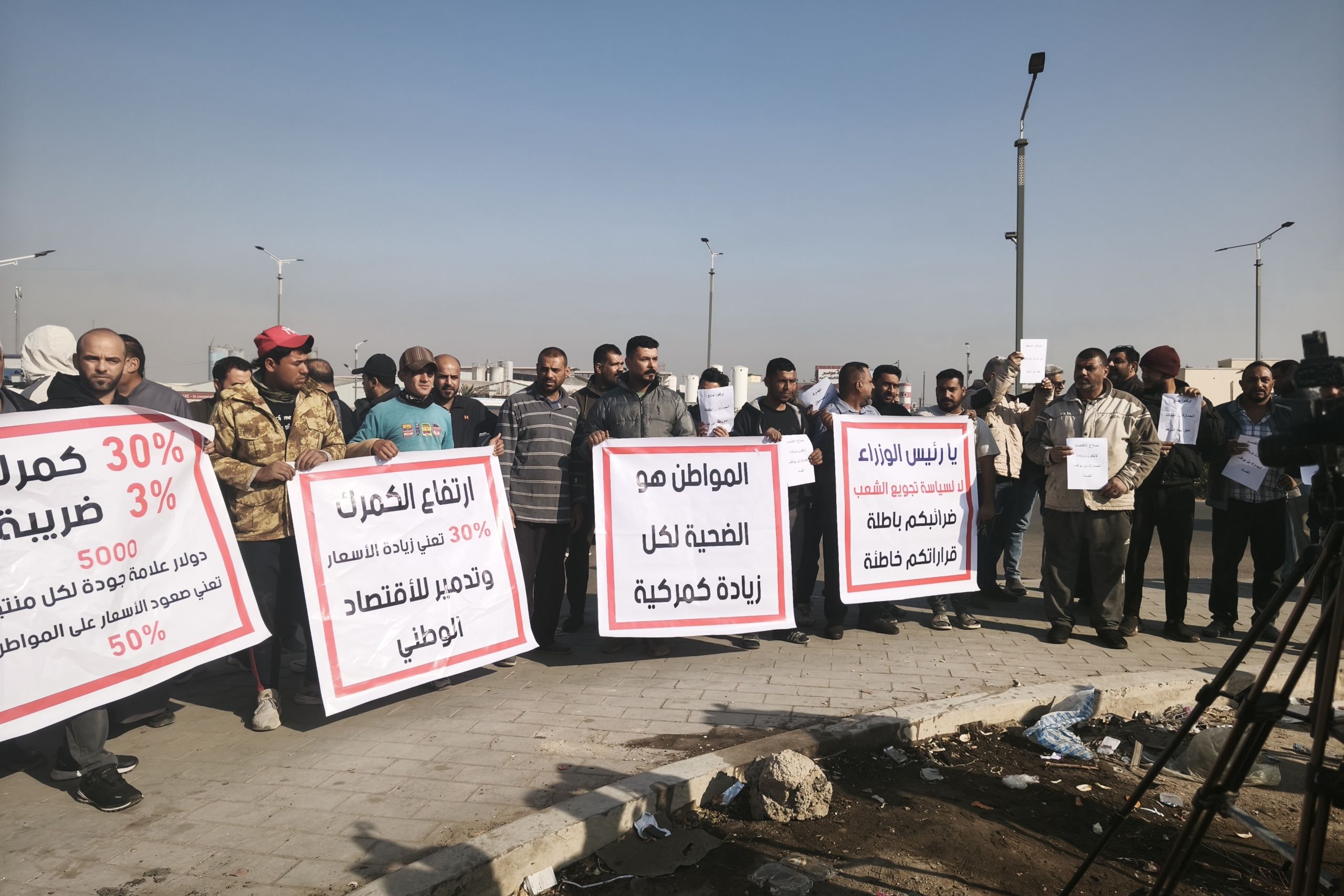
Cover photo: A group of Iraqi shop-keepers and business owners are protesting against the government’s decision to raise customs duties and taxes on imported goods, which caused a sharp increase in market prices. Basra, Iraq 8.1.2026. Picture: Mohammed_Al_Ali.
Kirjoittaja

Sini Al-Fraidawi
Kirjoittaja on teologian maisteri ja Lähi-idän tutkimuksen opiskelija Helsingin yliopistossa.
Aiheeseen liittyvät artikkelit
Irakin näyttävä korruptionvastainen kampanja ei ulotu vallan ytimeen
Valkoinen fosfori ja kansainvälisen oikeuden harmaa alue
Lähi-itä palaa! Aavikoituminen ja ympäristövahingot uhkaavat Kaksoisvirranmaata